
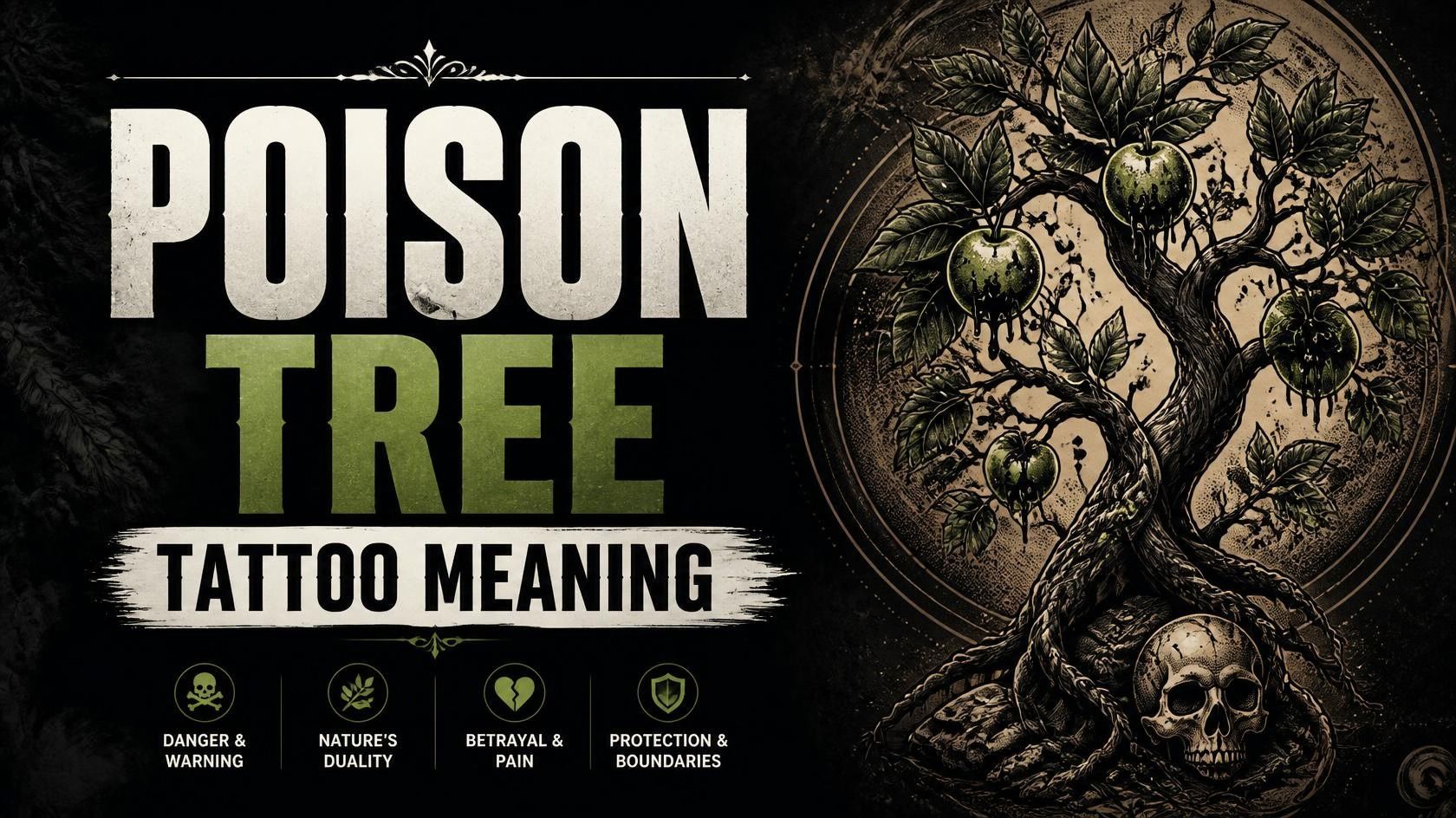

What if a beautiful tree could tell a story about anger, pain, and healing? A poison tree tattoo may look dark at first glance. Yet, its roots can carry a much deeper message. The design may represent hidden anger, betrayal, emotional wounds, or feelings that were never spoken. Twisted branches, rotten fruit, and deep roots can make the tattoo feel even more personal. For some people, it marks a painful chapter. For others, it shows strength after surviving difficult experiences.
The poison tree tattoo meaning comes from William Blake’s famous poem A Poison Tree. The poem shows how hidden anger can grow when you refuse to express it. Today, the symbol can represent emotional struggle, self-awareness, forgiveness, or healing. Its meaning can change with the design and the person wearing it. Some see it as a warning about bottled-up emotions. Others see it as a reminder to heal the roots instead of feeding the pain.
Poison Tree Tattoo Meaning – Quick Definition
The poison tree tattoo meaning centers on hidden anger, suppressed emotions, and pain that grows when left unspoken.
The image often works as a visual reminder of emotional wounds, inner struggle, and the consequences of silence.
Rather than carrying one fixed definition, this tattoo can reflect a person’s own story.
It may represent betrayal, heartbreak, emotional repression, or healing from toxic experiences.
Some people see the tree as a warning about bottling up emotions.
Others view it as a symbol of emotional growth after a painful chapter.
Core symbolism
- Hidden anger and unprocessed anger
- Unspoken resentment and emotional walls
- Silent pain and silent suffering
- Betrayal and relationship heartbreak
- Emotional damage and emotional numbness
- Revenge symbolism and its consequences
- Forgiveness and self-awareness
- Emotional growth and healing
The roots can represent feelings buried deep inside.
The branches can show how those feelings spread over time.
The fruit then represents the consequences created by those emotions.
That makes the poison tree tattoo meaning much deeper than simply calling it a dark tattoo.
Core symbolism
At its heart, the poison tree represents emotions that someone keeps inside.
Hidden anger can begin quietly. Over time, however, suppressed emotions may become unspoken resentment.
The tree becomes a metaphor for that emotional buildup.
Its roots can represent old emotional wounds.
Its branches may represent growing inner struggle.
Its fruit can symbolize the consequences of silence.
For some people, the image also reflects betrayal or emotional damage caused by toxic relationships.
The symbolism doesn’t always point toward revenge.
Instead, it can encourage reflection, forgiveness, and emotional honesty.
Common ideas include:
- Bottling up emotions
- Repressed anger metaphor
- Emotional repression
- Silent suffering
- Trust issues
- Emotional walls
- Self-awareness
- Emotional intelligence
- Healing and reflection
In this sense, the tattoo can tell a simple story: what you feed inside can eventually shape what grows outside.
Short quoted examples
Short phrases can make the poison tree tattoo meaning easier to understand.
They can also work as captions beside a tattoo photo or as inspiration for personal designs.
Here are several examples:
“Water your peace, not your anger.”
This phrase focuses on choosing healing instead of feeding resentment.
“I grew what I didn’t express.”
It connects directly with emotional repression and unspoken feelings.
“Healing the roots.”
This works well for someone who sees the tattoo as a sign of recovery.
“Smiling outside, poisoned within.”
The phrase highlights the contrast between appearance and inner struggle.
“What you hide can harm you.”
This captures the warning behind the symbolism.
Another fitting idea is hurt but healing identity.
That phrase gives the tattoo a softer direction.
It suggests that pain exists without allowing pain to define the person forever.
The best caption should match the wearer’s actual story.
A dramatic phrase shouldn’t replace genuine meaning.
Origin & Background
The literary roots of the poison tree tattoo meaning trace back to William Blake’s poem A Poison Tree.
Blake included the poem in Songs of Experience, published in 1794.
The poem uses a tree as a powerful metaphor for anger that grows after someone hides it.
The speaker handles anger toward a friend differently from anger toward an enemy.
One emotion gets expressed. The other remains hidden.
That contrast creates the poem’s central tension.
The hidden anger receives attention through fear, tears, smiles, and deceit.
Eventually, it grows into a tree that produces deadly fruit.
Modern tattoo culture has adapted this literary symbolism into visual form.
Gothic art and dark art often use trees to create mystery and emotional weight.
However, a poison tree tattoo doesn’t have to look purely gothic.
It can also become a piece of emotional storytelling.
Key message of the poem
The central lesson of A Poison Tree involves the danger of nurturing anger instead of addressing it.
Blake contrasts open communication with emotional concealment.
When the speaker tells his friend about his anger, the anger ends.
When he hides anger toward his foe, that anger grows.
The tree therefore becomes a picture of emotional buildup.
Its fruit represents the result of that growth.
This idea gives the poison tree tattoo meaning a strong psychological layer.
The tattoo can remind someone that silence doesn’t always make difficult emotions disappear.
Sometimes silence gives them room to grow.
The poem also leaves room for darker interpretations involving revenge and harm.
Still, the broader lesson can focus on emotional awareness.
A modern interpretation might ask:
- What happens when anger stays buried?
- Can honesty prevent emotional damage?
- How can reflection interrupt that cycle?
- Can forgiveness stop resentment from taking root?
Real-Life Conversations
A poison tree tattoo can invite questions because the design looks mysterious.
Someone might notice the twisted tree first. The deeper meaning usually comes after the conversation.
A friend may ask about the roots, fruit, or darker imagery.
The wearer can then explain the personal meaning without sharing every private detail.
For example:
Friend:
“That tree looks intense. Does it have a meaning?”
Owner:
“Yeah. It represents anger I kept inside for too long.”
Friend:
“So it’s about revenge?”
Owner:
“Not really. It’s more about learning what happens when you don’t deal with pain.”
That response shows why tattoo symbolism can have several layers.
A person might also connect the design with betrayal by friends, family conflict, bullying, or relationship heartbreak.
Another wearer may simply admire its literary symbolism.
The meaning depends on the person behind the ink.
WhatsApp Chat
WhatsApp conversations about tattoos usually feel casual.
Someone may send a photo and ask what the design represents.
The poison tree tattoo meaning can then become part of a short personal conversation.
Friend:
“What’s the story behind your new tattoo?”
Owner:
“It’s a poison tree. It represents emotions I kept buried.”
Friend:
“Like anger?”
Owner:
“Exactly. Hidden anger that eventually became impossible to ignore.”
Friend:
“That’s deeper than I expected.”
Owner:
“Yeah. It’s basically a reminder to stop bottling up emotions.”
The conversation doesn’t need to become overly serious.
A simple explanation can communicate the idea clearly.
For someone who prefers privacy, another response might work:
Owner:
“It has a personal meaning. Maybe I’ll tell you the full story someday.”
That keeps the discussion respectful.
The tattoo can speak for itself without requiring a detailed explanation.
Instagram DMs
Instagram DMs often begin with a simple compliment.
Someone might notice a poison tree design and ask about its meaning.
Follower:
“That tree tattoo is beautiful. What’s the story?”
Owner:
“It’s about hidden anger and healing.”
Follower:
“Does the fruit represent something?”
Owner:
“Yeah. It represents what can grow from emotions you never express.”
That explanation gives the poison tree tattoo meaning a personal angle.
Another wearer might describe it as healing the roots after a difficult period.
The phrase works especially well with designs showing new growth.
A more serious DM could mention betrayal, emotional walls, or trust issues.
A lighter conversation might simply focus on the artwork.
The important point is that Instagram allows both visual appreciation and deeper emotional storytelling.
The tattoo doesn’t need a single universal explanation.
TikTok Comments
TikTok comments can make tattoo meanings look simpler than they really are.
A viewer might see a dark tree and immediately assume revenge.
A creator can correct that assumption without becoming defensive.
Commenter:
“Is this a revenge tattoo?”
Creator:
“Not exactly. It’s about anger that I didn’t express.”
Commenter:
“So it’s more about healing?”
Creator:
“Yes. I see it as learning from the past.”
Another viewer might ask about the design.
Commenter:
“Why did you add the falling apples?”
Creator:
“They represent the consequences of emotions that keep growing.”
This kind of exchange shows how tattoo symbolism works online.
Global internet usage also creates many different interpretations.
Some viewers may focus on Gothic art.
Others may notice the William Blake connection.
The best explanation keeps the personal meaning at the center.
Emotional & Psychological Meaning
The emotional side of the poison tree tattoo meaning often involves feelings that remain unresolved.
A person may choose the design after betrayal, heartbreak, family conflict, bullying, or another painful experience.
The tree can represent how those emotions affected them over time.
Its roots suggest feelings that run deep.
Its branches suggest emotional complexity.
Its fruit can symbolize consequences.
For some people, the tattoo represents psychological trauma or a difficult period of emotional numbness.
For others, it becomes a reminder of healing.
Mental health awareness can also shape the interpretation.
The design may encourage self-awareness rather than shame.
In therapy spaces, the tree could work as a repressed anger metaphor.
Still, a tattoo cannot reveal someone’s mental state by itself.
The wearer decides what the image means.
That distinction matters because emotional symbolism remains deeply personal.
What mindset it reflects
A poison tree tattoo may reflect a mindset focused on introspection and reflection.
Someone might use the design to acknowledge an emotional struggle without hiding from it.
The symbolism can show emotional depth without automatically revealing someone’s personality.
For example, an introvert may choose a subtle tree because the image communicates something privately.
A deep thinker might appreciate its layered literary symbolism.
Artists, writers, musicians, designers, and other creatives may also connect with the visual metaphor.
However, no tattoo proves that someone belongs to one personality type.
The design may simply mark an important experience.
Possible themes include:
- Self-awareness
- Emotional intelligence
- Reflection
- Personal growth
- Learning from pain
- Recognizing emotional patterns
- Letting go of resentment
The mindset can therefore move from pain toward understanding.
Instead of celebrating anger, the tattoo may acknowledge it and encourage healthier choices.
Modern psychological interpretation
Modern interpretations often move beyond simple ideas about revenge.
The poison tree tattoo meaning can represent the emotional cost of leaving difficult feelings untreated.
Suppressed emotions don’t automatically become destructive. Yet unresolved resentment can affect relationships, decisions, and personal well-being.
That makes the tree a useful metaphor for emotional growth.
The roots represent what remains underneath the surface.
The branches show how feelings can spread into other parts of life.
The fruit represents an eventual result.
Someone recovering from toxic relationships might use the tattoo to symbolize new boundaries.
A trauma survivor may see it as a reminder of survival and healing.
Another person may connect it with emotional walls or trust issues.
These interpretations shouldn’t become assumptions about every wearer.
Instead, they show how tattoo culture can turn complex experiences into visual stories.
The image becomes a reminder to notice emotions before they take over.
Usage in Different Contexts
The meaning of a poison tree tattoo can shift slightly depending on the setting.
A tattoo shown on social media may invite artistic discussion.
A conversation with friends may reveal a more personal story.
In professional settings, viewers may simply see an unusual piece of dark art.
That difference explains why context matters.
The same design can feel playful in one situation and deeply emotional in another.
Consider these common contexts:
- Social media and online captions
- Friends and relationships
- Work and professional settings
- Artistic communities
- Tattoo studios
- Casual conversations
- Serious personal discussions
Even the tone can change the conversation.
A casual question might lead to a short answer.
A serious conversation may involve betrayal, healing, or emotional wounds.
The tattoo itself stays the same.
The surrounding context changes how people understand it.
1. Social Media
Social media gives people space to present tattoo symbolism through images and captions.
A poison tree tattoo might appear alongside a short phrase such as “Healing the roots”.
Another caption could say “Water your peace, not your anger.”
These phrases focus on growth rather than revenge.
Instagram may emphasize visual details.
TikTok may encourage quick explanations and comments.
Pinterest-style tattoo discussions may focus more on design inspiration.
The platform can influence how much context people receive.
A close-up image of rotten fruit may create a darker impression.
A blooming poison tree can suggest healing instead.
Social media also encourages simplified interpretations.
That means a caption can help explain the intended meaning.
If the tattoo represents something personal, the wearer doesn’t need to reveal every detail.
A short sentence can be enough.
The best caption adds context without turning a private experience into public entertainment.
2. Friends & Relationships
Within friends and relationships, the tattoo can carry a more personal meaning.
Someone may connect it with betrayal by friends or relationship heartbreak.
Another person may use it to represent trust issues created by a difficult experience.
The design can also symbolize emotional walls.
For example, someone might explain that the tree represents learning not to hide pain.
In a relationship, the tattoo doesn’t automatically signal anger toward a partner.
Its meaning depends on the person’s own story.
A thoughtful conversation can clear up misunderstandings.
Partner:
“Does your tattoo represent something that happened between us?”
Owner:
“No. It represents an older experience and what I learned from it.”
That simple explanation prevents unnecessary assumptions.
The tattoo can become a reminder of growth rather than a hidden message.
Personal meaning always matters more than outside guesses.
3. Work / Professional Settings
A poison tree tattoo may receive different reactions in work and professional settings.
Some workplaces may focus mainly on the artwork.
Others may interpret dark imagery differently depending on the environment.
In corporate environments, a highly visible tattoo could attract questions.
That doesn’t mean the design represents aggression.
It may simply reflect literary symbolism or personal storytelling.
For creative professionals, the imagery might feel natural.
Artists, writers, musicians, and designers may appreciate its layered meaning.
Still, professional settings often call for context and discretion.
A coworker might ask:
Coworker:
“What’s the meaning behind the tree?”
Employee:
“It’s inspired by William Blake and represents emotional growth.”
That answer keeps the conversation simple.
You don’t need to discuss trauma, relationships, or private experiences at work.
The tattoo can remain personal while still receiving respectful attention.
4. Casual vs Serious Tone
The poison tree tattoo meaning can support both casual and serious conversations.
In a casual setting, someone may simply say, “It’s a dark tree with a deeper meaning.”
That keeps things light.
A serious conversation may focus on emotional wounds, betrayal, or healing.
The tone should match the relationship and situation.
Casual example
Friend:
“Cool tattoo. Is that a poison tree?”
Owner:
“Yep. It’s a Blake reference.”
Serious example
Friend:
“Does it represent something painful?”
Owner:
“Yeah. It reminds me not to keep anger buried.”
Neither answer needs to reveal more than the wearer wants.
Humor can work with close friends.
However, sensitive stories deserve respectful responses.
The same tattoo can therefore support different conversations.
Context determines how much emotional depth belongs in the discussion.
Common Misunderstandings
Poison tree tattoos often attract assumptions because the imagery looks dark.
Some people immediately connect the design with revenge or violence.
Others assume that anyone wearing one has unresolved anger.
Those conclusions don’t necessarily follow from the artwork.
The tattoo may instead represent reflection, emotional growth, or healing.
Common misunderstandings include:
- Revenge symbolism means revenge behavior
- Dark imagery means violent intentions
- A poison tree is always purely gothic
- The wearer must have emotional problems
- The design has one universal definition
Literary symbolism provides one important layer.
Personal experience adds another.
Design choices can change the visual message too.
A burning tree may feel darker than a blooming one.
A heart shaped root system may suggest relationship pain.
The safest interpretation comes from asking the wearer.
A tattoo can suggest a story without telling the whole story.
Misconception 1 It means revenge
The idea of revenge often appears because A Poison Tree contains conflict between the speaker and an enemy.
That connection makes revenge symbolism understandable.
However, a poison tree tattoo doesn’t automatically mean the wearer wants revenge.
The design can instead represent the emotional consequences of resentment.
For one person, it may symbolize anger.
For another, it may represent the lesson learned from anger.
For someone else, it may simply honor William Blake’s literary work.
Consider this response:
Person:
“Is your tattoo about getting revenge?”
Owner:
“No. It’s about what happens when resentment grows.”
That distinction matters.
Revenge focuses on harming another person.
The tattoo may focus on recognizing destructive emotions instead.
Its message can become one of self-awareness.
In some cases, the wearer may even connect the design with forgiveness.
The tree can therefore represent a warning rather than a threat.
Misconception 2 It’s anti-social or violent
A dark tree doesn’t automatically suggest an anti-social or violent personality.
That assumption creates an anti-social or violent myth around the design.
Many people choose dark art because they enjoy symbolism, atmosphere, or literary references.
The tattoo might reflect emotional depth rather than aggression.
Someone may choose it after a painful experience.
Another person might simply love the visual contrast between roots, branches, and fruit.
Even a skull beneath the tree doesn’t prove violent intentions.
Art often uses dramatic imagery to communicate complex ideas.
The same applies to Gothic art.
Dark visual language can represent grief, mystery, transformation, or introspection.
If someone asks about the tattoo, a simple conversation usually clears things up.
The artwork provides a clue.
The wearer provides the actual meaning.
That distinction helps avoid unfair assumptions about personality.
Misconception 3 It’s purely gothic
The poison tree tattoo can certainly have a gothic appearance.
Twisted branches, dark shading, skulls, and moonlit backgrounds create a strong Gothic art aesthetic.
Yet calling it purely gothic misses its literary and emotional layers.
The design can also represent:
- William Blake’s poetry
- Emotional storytelling
- Hidden anger
- Self-awareness
- Healing
- Reflection
- Personal growth
A blooming poison tree may look surprisingly beautiful.
A heart shaped root system can make the design feel intimate.
A simple black tree can create a quiet, minimalist effect.
So the purely gothic myth doesn’t fit every version.
Dark art often carries multiple meanings at once.
The visual style may attract someone first.
The symbolism may become the reason they keep the design.
That combination gives the tattoo much more depth than appearance alone.
When it should NOT be used
A poison tree tattoo may not suit every message.
If you want pure positivity, this design may send a different signal.
Its traditional symbolism involves conflict, anger, emotional struggle, and consequences.
That can feel too heavy for someone seeking a cheerful symbol.
It may also be a poor choice if you want a straightforward symbol of spiritual enlightenment.
Similarly, someone looking for uncomplicated family love may prefer another design.
Consider alternatives such as:
- Phoenix for rebirth
- Olive branch for peace
- Tree of Life for connection
- Blooming flowers for renewal
The poison tree works better when you want emotional complexity.
It can represent pain, lessons, or healing.
However, you should choose imagery that matches your intended message.
A tattoo lasts longer than a passing trend.
Make sure the symbolism feels right to you.
Comparison Table
The poison tree differs from several familiar tattoo symbols.
| Symbol | Common meaning | Emotional tone |
| Poison Tree | Hidden anger and consequences | Dark and reflective |
| Broken sword | Defeat, surrender, or an ended struggle | Somber |
| Phoenix | Rebirth and transformation | Hopeful |
| Wilted rose | Lost love or fading beauty | Sad and romantic |
| Snake tattoo | Transformation, danger, or renewal | Complex |
| Olive branch | Peace, forgiveness, and reconciliation | Positive |
The comparison shows why the poison tree tattoo meaning feels distinctive.
A phoenix usually points toward renewal.
An olive branch leans toward peace.
A wilted rose often focuses on loss.
The poison tree focuses more strongly on emotions that grow when someone doesn’t address them.
Still, meanings can overlap.
A poison tree may include healing just as a phoenix can represent pain before rebirth.
Tattoo symbolism isn’t a strict dictionary.
Personal experience always adds another layer.
Variations / Types of Poison Tree Tattoos
Different design choices can completely change the mood of a poison tree tattoo.
The same basic tree can look threatening, sorrowful, peaceful, or hopeful.
For example, rotten fruit creates a darker impression.
Fresh leaves may suggest recovery.
A tree sleeve can combine several symbols into one larger story.
Common variations include:
- Twisted tree
- Bare branches
- Falling fruit
- Rotten fruit
- Falling apples
- Snake around the tree
- Dead tree
- Half-alive half-dead tree
- Tree growing from heart
- Skull beneath the tree
- Blooming poison tree
- Tree in darkness with moon
- Burning poison tree
- Visible tree roots
Each element can add meaning.
The most important choice is the emotional story behind the design.
1. Tree With Rotten Fruit
A tree with rotten fruit creates one of the clearest darker interpretations.
The fruit can represent harmful results produced by unresolved emotions.
It may symbolize resentment that has remained unchecked.
The rotten appearance suggests that something once capable of growth has become unhealthy.
For some people, this represents emotional damage from a difficult relationship.
For others, it may represent the consequences of silence.
The design can also connect with unprocessed anger.
A person might choose it after recognizing how long they carried resentment.
The roots can remain strong while the fruit appears damaged.
That contrast creates an interesting message.
It says that something can continue growing while still producing unhealthy results.
The design works especially well for people who want the darker side of the poison tree tattoo meaning.
It isn’t necessarily about revenge.
Instead, it can represent recognition, consequences, and change.
2. Snake Around the Tree
A snake around the tree adds another layer of symbolism.
Snake imagery often carries several meanings, including danger, transformation, temptation, and renewal.
When wrapped around a poison tree, it can create a stronger sense of emotional toxicity.
Some people may connect it with betrayal or trust issues.
Others may see the snake as a symbol of change.
The combination can represent toxic relationships or painful lessons.
For example:
Tree: hidden emotions
Snake: danger or transformation
Fruit: consequences
Together, these elements create a complicated emotional story.
The design doesn’t have one universal definition.
Its meaning depends on the wearer and the surrounding artwork.
A realistic snake can make the tattoo feel darker.
A minimalist snake can create a subtler effect.
This variation works well for someone who wants literary symbolism mixed with strong visual drama.
3. Dead Tree Version
A dead tree version often represents emotional numbness or the end of a painful chapter.
Bare branches create a sense of emptiness.
The missing leaves can suggest that something once alive has faded.
For some people, the design represents prolonged emotional struggle.
For others, it may symbolize leaving an old identity behind.
A dead tree doesn’t have to mean permanent despair.
It can also represent the quiet period before renewal.
Adding small new leaves can change the message completely.
The tree then becomes a visual reminder of recovery.
This version can suit someone who connects with silent pain or silent suffering.
It may also reflect the aftermath of betrayal or loss.
The image feels simple, yet its meaning can run deep.
Sometimes an empty tree says more than a crowded design.
The surrounding details determine whether it feels hopeless, reflective, or quietly hopeful.
4. Tree With Falling Apples
Falling apples connect strongly with the literary origin of the poison tree.
In Blake’s poem, the tree produces an apple that carries the story toward its dark ending.
A tattoo can use falling apples to emphasize consequences and emotional buildup.
Each apple may represent a different feeling, event, or unresolved issue.
The design can also suggest time passing.
One apple may remain on the tree while another falls.
That visual contrast creates a sense of movement.
The tattoo could represent anger that has already produced consequences.
It may also symbolize the moment someone finally recognizes the result of their actions.
Some designs use bright red apples against dark branches.
That creates an eye-catching contrast.
Others keep everything black and gray for a quieter mood.
Either way, falling apples give the tattoo a clear literary connection.
5. Half-Alive Half-Dead Tree
A half-alive half-dead tree creates a powerful contrast.
One side may show bare branches and dark roots.
The other side may display leaves, blossoms, or fresh growth.
This design can represent emotional growth after suffering.
It suggests that pain and healing can exist at the same time.
The dead side may represent an old chapter.
The living side can symbolize recovery and new direction.
This makes the tattoo less focused on darkness alone.
It can become a visual record of transformation.
Someone recovering from toxic experiences might choose this design to show progress.
Another person may use it to represent emotional balance.
The contrast also works beautifully as a larger tattoo.
Roots can connect both sides of the tree.
That detail suggests that the past remains part of the story without controlling the future.
6. Tree Growing From Heart
A tree growing from the heart creates a strongly emotional design.
The heart connects the tree directly with love, relationships, and personal feelings.
Its roots may represent emotional wounds buried inside the heart.
The branches can symbolize feelings that continue growing over time.
For some people, this design relates to relationship heartbreak.
For others, it represents betrayal, love, or emotional healing.
The image can also suggest that pain became part of personal growth.
A dark tree emerging from a heart creates a dramatic contrast.
Adding small flowers can soften the design.
Adding rotten fruit can make the message darker.
A heart shaped root system may emphasize emotional depth.
This version suits people who want the tattoo to feel personal rather than purely literary.
It can tell a simple story:
Something hurt the heart, but the experience eventually became part of the person’s growth.
7. Skull Beneath the Tree
A skull beneath the tree creates one of the darkest variations.
The skull can symbolize mortality, emotional death, or the final consequences of destructive feelings.
Placed under poisonous branches, it creates a strong sense of danger.
However, the design doesn’t automatically mean violence.
It may represent the emotional numbness that follows prolonged pain.
Some people also use skull imagery to show the end of an old identity.
That interpretation turns the design toward transformation.
The surrounding details matter greatly.
A skull with rotten fruit creates a sinister mood.
A skull beneath a blooming tree creates a more complicated message.
The contrast can suggest that growth continues even after something has ended.
This version often fits Gothic art and dark art styles.
Still, its meaning remains personal.
If the skull feels too severe, adding flowers, light, or fresh leaves can create a softer balance.
8. Blooming Poison Tree
A blooming poison tree offers a more hopeful interpretation.
The tree still carries the idea of emotional struggle.
However, flowers suggest growth, healing, and renewal.
This design can represent someone who has survived a difficult period.
The past may have included betrayal, silent suffering, or emotional damage.
The blooming branches show what came afterward.
It can also represent self-awareness.
Instead of hiding painful emotions, the wearer acknowledges them and moves forward.
The design fits the idea of a hurt but healing identity particularly well.
A small amount of darkness can remain in the roots.
Bright flowers can appear higher on the branches.
That contrast creates a visual journey from pain to recovery.
The tattoo doesn’t erase the difficult past.
Instead, it shows that something beautiful can grow from a complicated experience.
For many people, that’s a gentler interpretation of the poison tree.
9. Tree in Darkness With Moon
A tree in darkness with a moon creates a quiet, mysterious atmosphere.
The design often emphasizes loneliness, introspection, and inner darkness.
Bare branches can reach toward the moon.
Deep shadows can surround the tree roots.
This version works especially well for someone drawn to dark art or atmospheric tattoo styles.
The moon can also represent reflection.
Its light offers a small contrast against the darkness.
That contrast may suggest that difficult emotions aren’t the whole story.
Some people may connect the image with silent pain.
Others may see it as a symbol of emotional depth.
A moonlit poison tree can also fit literary communities because it feels like a visual scene from a poem.
The design doesn’t need dramatic imagery.
Sometimes a simple tree, moon, and empty sky create the strongest effect.
Its meaning can remain mysterious until the wearer chooses to explain it.
10. Burning Poison Tree
A burning poison tree creates a dramatic image of release.
Fire can represent destruction, transformation, anger, or the decision to let go.
When paired with a poison tree, the design may suggest ending a cycle of emotional repression.
The roots can symbolize old pain.
The flames can represent the process of releasing it.
This makes the design especially interesting for someone focused on healing.
It can also symbolize leaving toxic relationships or unhealthy patterns behind.
Unlike a simple dead tree, the burning version shows active change.
Something is being destroyed so something new can begin.
The design can connect with forgiveness too.
Letting go doesn’t mean forgetting what happened.
Instead, it can mean refusing to keep feeding the same anger.
That makes the burning poison tree a powerful final variation.
It transforms a symbol of hidden anger into a reminder that emotional cycles can end.
How to Respond When Someone Uses or Shows This Tattoo
When someone shows you a poison tree tattoo, don’t assume its meaning right away. The poison tree tattoo meaning can vary from hidden anger to healing and personal growth.
The best response depends on your relationship with the person and the situation. A close friend may welcome a deeper question. A stranger may prefer a simple compliment.
You can start with an open question:
You:
“That’s an interesting design. Does it have a personal meaning?”
Tattoo owner:
“Yeah. It represents something I went through.”
You:
“I can see why you chose it. The symbolism feels pretty deep.”
Good responses usually show curiosity without demanding private details.
- Ask before assuming.
- Listen if they want to explain.
- Respect their boundaries.
- Avoid labeling them based on the tattoo.
- Let them decide how much to share.
A thoughtful response can turn a simple tattoo conversation into a meaningful exchange.
Casual Replies
Casual replies work well when you’re talking with friends, classmates, or someone you barely know.
You don’t need to make the conversation serious immediately. A simple comment can show interest without putting pressure on the wearer.
For example:
You:
“That poison tree looks really cool. What’s the story?”
Tattoo owner:
“It’s about hidden anger and learning to let it go.”
You:
“That’s deeper than I expected.”
You can also keep the conversation short:
- “That’s a seriously interesting design.”
- “I like the tree detail.”
- “Is it inspired by William Blake?”
- “The symbolism is pretty unique.”
- “What made you choose this design?”
If the person doesn’t want to explain, don’t push.
The poison tree tattoo meaning may involve emotional wounds, betrayal, or silent suffering.
Some stories remain private.
A casual response should leave room for that.
Funny Replies
Funny replies can work when you already know the person well.
Humor can make the conversation lighter, especially when the tattoo has a dramatic appearance.
For example:
You:
“Should I be worried about the fruit on that tree?”
Friend:
“Only if you annoy me.”
You:
“Noted. I’ll stay on my best behavior.”
Another playful response could be:
You:
“So you’re officially an emotional gardener now?”
Friend:
“Apparently.”
You:
“At least water your peace, not your anger.”
You can also use light comments such as:
- “That tree definitely has a backstory.”
- “Okay, that’s one intense garden.”
- “I’m guessing those apples aren’t for lunch.”
- “That tree looks like it has trust issues.”
- “That’s some serious emotional landscaping.”
Still, humor needs good timing.
Don’t joke about trauma, psychological trauma, family conflict, or painful relationships unless the person clearly welcomes that tone.
A funny reply should feel friendly, not dismissive.
Mature / Confident Replies
A mature response recognizes that the poison tree tattoo meaning may carry serious emotional weight.
Instead of making assumptions, acknowledge the symbolism with confidence and respect.
For example:
You:
“That’s a powerful design. The idea of turning emotional struggle into art really stands out.”
Tattoo owner:
“That’s exactly what I wanted.”
You:
“It definitely feels intentional.”
Other mature replies include:
- “The symbolism has a lot of depth.”
- “That’s a meaningful way to represent personal growth.”
- “I respect the thought behind the design.”
- “It looks like more than just dark art.”
- “The contrast between pain and healing is interesting.”
You can also mention literary symbolism if the design references Blake.
You:
“Is this connected to William Blake’s A Poison Tree?”
That question shows genuine interest without making a personal judgment.
A confident response doesn’t need dramatic language.
Sometimes a calm sentence says enough.
Private / Respectful Replies
Some poison tree tattoos represent deeply personal experiences.
The wearer may have dealt with betrayal, relationship heartbreak, bullying, family conflict, or another difficult period.
In those situations, a private and respectful response works best.
You could say:
You:
“That looks meaningful. If there’s a story behind it, I’d listen if you ever want to share.”
Tattoo owner:
“Thanks. It’s pretty personal.”
You:
“Of course. No pressure.”
That approach gives the person control over the conversation.
Useful responses include:
- “You don’t have to explain it.”
- “I respect that it’s personal.”
- “If you ever want to talk, I’m here.”
- “The design speaks for itself.”
- “I hope the tattoo represents healing for you.”
Avoid saying things like, “You must have anger issues.”
Don’t assume the wearer has emotional problems based on their artwork.
The poison tree tattoo meaning belongs to the person wearing it.
Respect matters more than curiosity.
Regional & Cultural Usage
The poison tree tattoo meaning can receive different interpretations across cultures.
However, these interpretations aren’t universal rules. Personal beliefs, religion, literature, tattoo culture, and individual experiences can all influence how someone understands the image.
In Western culture, William Blake provides the clearest literary connection.
Elsewhere, viewers may connect tree imagery with spiritual ideas, nature, morality, or emotional balance.
Online communities also mix these interpretations together.
Possible themes include:
- Literary symbolism
- Spiritual interpretation
- Karma
- Inner poison harming the soul
- Life energy
- Emotional healing
- Moral lessons about forgiveness
It’s important to avoid treating broad regional categories as fixed meanings.
A person from one culture may interpret the design completely differently from another person nearby.
Context matters.
So does the individual’s personal story.
Western Culture
In Western culture, the strongest literary connection comes from William Blake’s A Poison Tree.
Blake published the poem in Songs of Experience in 1794. Its central metaphor involves anger that grows when the speaker keeps it hidden.
That literary background strongly influences modern interpretations of the tattoo.
A Western viewer familiar with the poem may associate the design with:
- Hidden anger
- Suppressed emotions
- Unspoken resentment
- Revenge
- Consequences
- Emotional repression
- Reflection
Tattoo culture can also blend the poem with Gothic art and dark art.
However, not every Western wearer chooses the design because of Blake.
Some people simply like the visual symbolism.
Others connect it with personal experiences.
A tattoo may therefore carry literary meaning and personal meaning at the same time.
The phrase poison tree tattoo meaning covers several interpretations rather than one strict definition.
Asian Culture
In Asian contexts, tree imagery can intersect with spiritual and philosophical ideas.
However, there isn’t one single Asian interpretation of a poison tree tattoo.
Different countries, religions, philosophies, and individuals can understand the imagery in very different ways.
Some viewers may connect the tree with ideas involving:
- Karma
- Emotional balance
- Spiritual interpretation
- Inner poison harming the soul
- Life energy
- Personal transformation
- Moral lessons
These ideas don’t necessarily come directly from William Blake’s poem.
They may instead come from broader cultural or spiritual associations with trees, nature, consequences, and inner life.
For that reason, the poison tree tattoo meaning should not be presented as having one fixed Asian definition.
Someone may see a dark tree as a symbol of emotional struggle.
Another person may focus on growth and renewal.
The surrounding design and the wearer’s own beliefs usually provide better clues than geography alone.
Middle Eastern Culture
In Middle Eastern contexts, interpretations can also vary considerably.
A poison tree tattoo may be viewed through literary, artistic, personal, or spiritual ideas.
Some viewers might connect the image with themes such as hidden hostility, betrayal, consequences, forgiveness, or moral reflection.
Others may focus entirely on the visual design.
The concept of a poisonous tree can also invite symbolic ideas about harmful emotions and their effects.
Possible interpretations include:
- Hidden resentment
- Emotional struggle
- Moral reflection
- Forgiveness
- Karma
- Consequences
- Spiritual interpretation
Still, these themes shouldn’t be treated as universal Middle Eastern beliefs.
The region includes many cultures and traditions.
Individual religious and social views can also differ significantly.
Someone may appreciate the design purely as art.
Another person may connect it with a personal experience.
When discussing the poison tree tattoo meaning, asking the wearer what it represents remains more reliable than assigning a regional interpretation.
Global Internet Usage
Global internet usage has made tattoo symbolism much more fluid.
A poison tree tattoo can appear on Instagram, TikTok, Pinterest, Reddit, WhatsApp, and other online spaces.
Each platform can encourage a different style of conversation.
Instagram often emphasizes visual design.
TikTok can turn the symbolism into short explanations or comment discussions.
WhatsApp usually creates more personal conversations between friends.
Online users may describe the design with phrases such as:
- “Healing the roots”
- “Water your peace, not your anger”
- “I grew what I didn’t express”
- “Smiling outside, poisoned within”
- “What you hide can harm you”
The phrase hurt but healing identity also captures a modern interpretation.
Some users focus on Blake’s poem.
Others connect the tattoo with emotional growth, toxic relationships, or personal transformation.
Because the internet mixes cultures and interpretations, meanings can overlap quickly.
The wearer still has the final say over what the tattoo represents.
FAQS
Is a poison tree tattoo negative?
The poison tree tattoo meaning can reflect pain, anger, or emotional wounds.
However, it can also represent healing, reflection, forgiveness, and growth.
Does it mean revenge?
The poison tree tattoo meaning does not always suggest revenge or anger.
For some people, it represents consequences, emotional pain, or lessons learned.
Is it based on literature?
Yes, the poison tree tattoo meaning connects with William Blake’s 1794 poem A Poison Tree.
The poem appears in Songs of Experience and explores anger, silence, and consequences.
Can it symbolize healing?
Yes, the poison tree tattoo meaning can represent healing from emotional wounds and toxic experiences.
It may symbolize self-awareness, forgiveness, growth, and releasing suppressed emotions.
Is it a common tattoo?
The poison tree tattoo meaning appears in tattoo culture, especially among people drawn to literary symbolism.
Its popularity varies, while designs often feature twisted trees, roots, or falling fruit.
What personalities choose this tattoo?
The poison tree tattoo meaning may appeal to introverts, deep thinkers, artists, writers, and other creatives.
Still, tattoo choices are personal and never define someone’s personality completely.
Does placement change meaning?
The poison tree tattoo meaning can feel more personal depending on its placement and design.
A chest, arm, or back tattoo may emphasize privacy, visibility, memory, or personal expression.
Conclusion
The poison tree tattoo meaning goes far beyond a dark or mysterious design. It can represent hidden anger, silent pain, betrayal, emotional wounds, or feelings left unspoken. For some people, it reflects a difficult chapter of life. For others, it represents self-awareness, forgiveness, and healing. The roots, branches, fruit, and overall style can also add a personal touch to the message.
Inspired by William Blake’s A Poison Tree, this tattoo can remind you that unprocessed emotions may grow when they stay hidden. However, its meaning is not always about revenge or negativity. It can also show emotional growth and a decision to heal. Whether you choose a twisted tree, falling fruit, or blooming design, the story behind it matters most. In the end, your tattoo can become a visual reminder to understand your feelings, release old pain, and protect your peace.

