
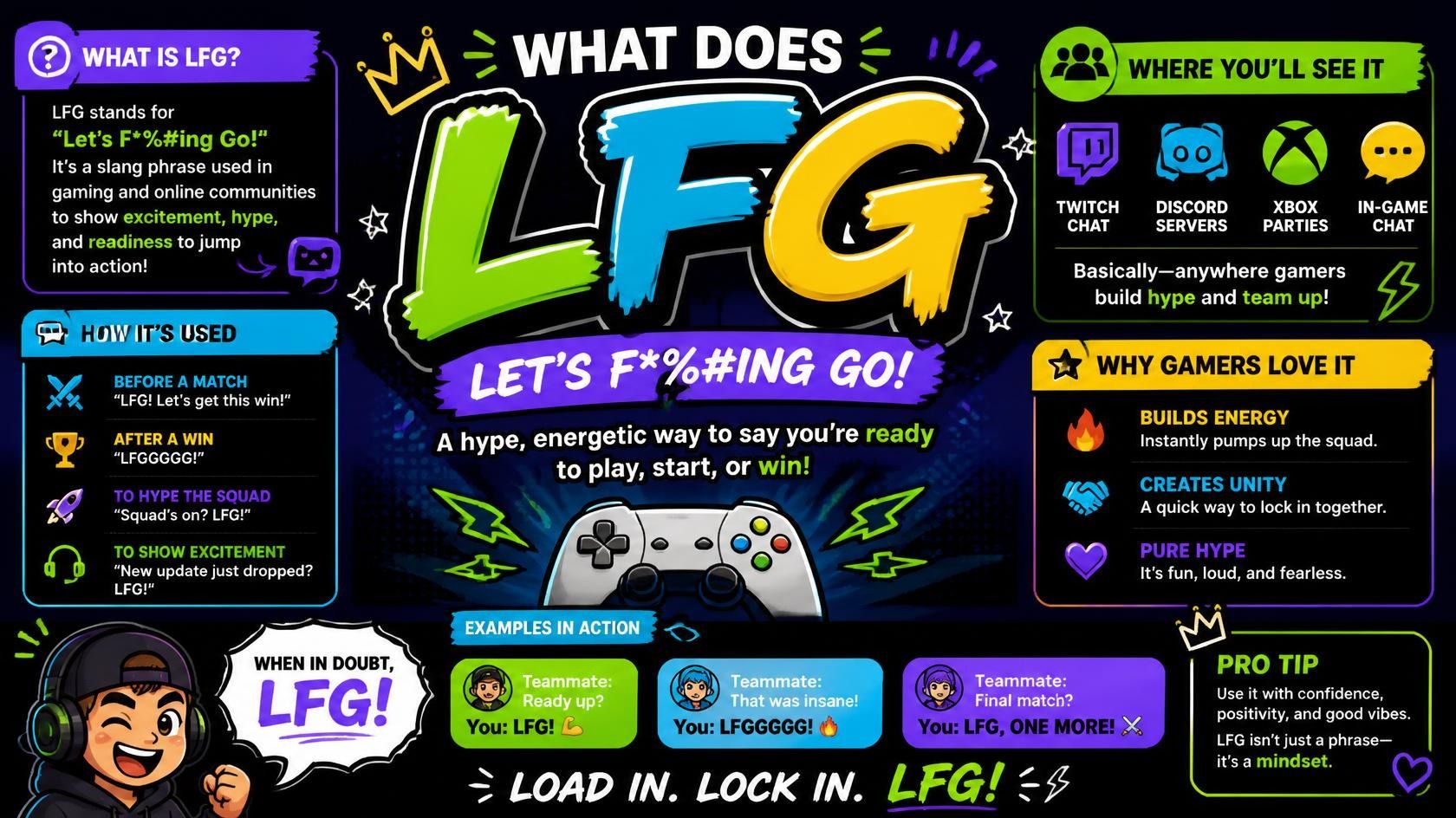

Have you ever seen someone type “LFG!!!” in a group chat or gaming conversation? This popular abbreviation can mean different things depending on the situation. In everyday slang, it often expresses excitement. In gaming, it helps players find teammates.
Understanding what does LFG mean becomes much easier when you look at the surrounding conversation. Someone celebrating a promotion probably means something different from a player searching for a dungeon group.
This guide explains both meanings with simple definitions, real-life conversations, and practical examples. You’ll also learn when to use LFG, how to respond, and why context matters across social media, gaming chats, and professional online spaces.
LFG Meaning – Quick Meaning
LFG has two common meanings. The right definition depends on who uses it and what they’re discussing.
- Let’s F*ing Go: An expression of excitement, celebration, or motivation.
- Looking For Group: A request to find teammates in an online multiplayer game.
For example, someone who just passed a driving test might post, “LFG!” to celebrate. A gamer might write, “LFG for tonight’s raid,” to find other players.
When people ask what does LFG mean, these two definitions provide the quickest answer. The surrounding words usually reveal which one fits.
Simple Definition
LFG is an abbreviation used in text messages, gaming chats, and social media. Its meaning changes with the context.
The slang version expresses strong enthusiasm. It can mean “Let’s go!” with implied profanity that adds extra energy.
The gaming version has a practical purpose. It tells other players that someone wants to join a group or find teammates.
Remember these simple distinctions:
- Celebration: “Got the new job. LFG!”
- Gaming: “Level 60 player LFG for a dungeon run.”
- Cleaner alternative: “Let’s go!”
- Gaming variation: “LFG ranked matches tonight.”
Once you recognize the situation, interpreting LFG becomes straightforward.
Examples
A few everyday examples show how people use LFG naturally. Notice how the meaning changes between celebration and gaming.
- New job announcement: “I got promoted today. LFG!”
- Booked tickets: “Our concert tickets are confirmed. LFG!”
- Fitness transformation: “Six months of training paid off. LFG!”
- Gaming chats: “LFG for a raid after dinner.”
- Sports fans: “We won the championship. LFG!!!”
Here’s another example:
Friend A: “I finally launched my website!”
Friend B: “LFG! You worked hard for this.”
In the first message, LFG celebrates an achievement. In a gaming chat, the same abbreviation might mean “Looking For Group.”
That dual meaning explains why context matters so much.
Origin & Background
LFG developed within online communication and gaming culture. Players needed quick ways to coordinate, while internet users wanted short expressions for strong emotions.
The gaming meaning stands for “Looking For Group.” It became useful in multiplayer environments where players needed teammates for missions, matches, raids, and dungeon runs.
The motivational slang meaning stands for “Let’s F*ing Go.” People use it to celebrate winning, good news, and personal milestones.
These meanings serve different purposes, even though they share the same abbreviation. One helps people organize a gaming session. The other communicates excitement in just three letters.
The exact timeline of the slang meaning’s rise requires reliable historical evidence. It’s best to distinguish established usage from assumptions about when a phrase became popular.
The Gaming Origin
Online multiplayer games often require teamwork. Players may need a full group before entering a raid, completing a difficult mission, or competing in ranked matches.
LFG offers a quick way to find those teammates. Instead of writing a long request, someone can post a short message in gaming chats or community forums.
Common examples include:
- “LFG dungeon run.”
- “Level 60 player LFG for tonight’s raid.”
- “LFG ranked matches with experienced teammates.”
- “Two players needed. LFG for weekend missions.”
For gamers, this abbreviation works like a small recruitment notice. It tells other players that someone wants to join a group or form one.
In this context, LFG usually has nothing to do with celebration. It’s about finding people to play with.
The Motivational Slang Origin
Outside gaming, LFG often stands for “Let’s F*ing Go.” People use it to express excitement, confidence, determination, or encouragement.
The phrase fits moments when something finally goes right. It might follow a promotion, graduation, sporting victory, or successful business launch.
For example:
Friend A: “I passed my driving test!”
Friend B: “LFG! Congratulations!”
Athletes, influencers, creators, celebrities, and sports fans may also use the phrase in posts and comments. It adds energy without requiring a long explanation.
You might see “LFGGG” after a major win or “LFG!!!” under an exciting announcement. Both versions amplify the emotion.
Although the phrase has implied profanity, many people use it casually. In formal situations, however, a cleaner alternative may work better.
Real-Life Conversations
Real-life conversations show how LFG works across different platforms. The meaning often becomes clear from the message that comes before it.
For example, a friend announcing an engagement probably expects congratulations. A player asking for a raid group wants help finding teammates.
Here are a few realistic examples:
- Celebration: “I got the promotion!”
- Encouragement: “LFG! You earned it.”
- Gaming: “Anyone LFG for tonight’s dungeon?”
- Social plans: “We booked the tickets. Weekend LFG!”
Pay attention to the subject, tone, and surrounding words. These clues help you understand the abbreviation without guessing.
The following conversations demonstrate how LFG appears in common online settings.
WhatsApp Conversation
WhatsApp group chats often mix everyday updates, jokes, celebrations, and plans. LFG fits naturally when friends share exciting news.
Example conversation:
Alex: “Guess what? I passed my driving test today!”
Sam: “LFG! I knew you’d do it.”
Alex: “Thanks! Now I can finally drive myself to work.”
Here, LFG expresses excitement and encouragement. It doesn’t refer to finding a gaming group.
Friends might also use it when planning vacations, celebrating an engagement, or sharing a new job announcement. However, the phrase may feel too energetic for serious or sensitive news.
If your family chat includes people who dislike profanity, “Let’s go!” or “That’s awesome!” communicates the same excitement more gently.
Instagram DM
On Instagram, LFG often appears in private messages between friends, creators, and followers. It can celebrate personal achievements or encourage someone pursuing a goal.
Example conversation:
Mia: “I just booked my first solo trip!”
Jordan: “LFG! You’re going to have an amazing time.”
Mia: “I’m excited but a little nervous.”
Jordan: “You’ve got this. Enjoy every minute.”
In this exchange, LFG communicates enthusiasm and support. The reply also shows that encouragement doesn’t need to stop at a single abbreviation.
Instagram users may also use LFG after sharing a new business achievement, fitness transformation, or milestone. The phrase works best when the situation calls for celebration.
TikTok Comments
TikTok comments often use short, energetic phrases to react to creators’ achievements. LFG is especially suitable when viewers want to show support quickly.
Example post:
Creator: “Finally reached 100,000 followers! Thank you for being here.”
Commenter 1: “LFG!!! You deserve this.”
Commenter 2: “Been following since day one. Big LFG!”
Commenter 3: “Congratulations! This is huge.”
The abbreviation conveys excitement without taking up much space. Extra letters and exclamation points can make the response feel even more enthusiastic.
Creators may also see LFG under fitness videos, business launches, and clips celebrating sporting victories. Still, context matters. A serious announcement deserves a thoughtful response rather than automatic hype.
Text Message
Text messages are one of the simplest places to encounter LFG. Friends use it to celebrate good news, encourage each other, or build excitement around upcoming plans.
Example conversation:
Taylor: “The interview went really well. They said they’ll call tomorrow.”
Chris: “LFG! Fingers crossed for you.”
Taylor: “I really hope I get it.”
Chris: “You prepared well. You’ve got a great shot.”
Here, LFG shows enthusiasm and optimism. It doesn’t guarantee success. Instead, it communicates support in a casual tone.
Someone might also text “LFG!” after getting engaged, booking tickets, buying a new car, or completing a difficult fitness goal.
When the news involves disappointment or uncertainty, a calmer response may feel more appropriate.
Emotional & Psychological Meaning
LFG does more than shorten a sentence. In casual conversations, it communicates an emotional burst that might otherwise take several words to explain.
The phrase can signal excitement, motivation, confidence, or a feeling of victory. It may also encourage people to take action and maintain momentum toward a goal.
People commonly use it when they feel:
- Excited about good news.
- Motivated to begin a challenge.
- Confident after making progress.
- Energized by a team achievement.
- Victorious after winning a competition.
For example, “First marathon completed. LFG!” combines pride with celebration.
The phrase can also create a sense of shared enthusiasm. Friends, teammates, and supporters use it to show they’re cheering someone on.
However, LFG doesn’t always reveal someone’s deeper emotional state. Sometimes it’s simply a playful reaction or a familiar internet expression.
Usage in Different Contexts
LFG changes meaning depending on the platform, audience, and conversation. Understanding the context helps you avoid awkward replies.
In social settings, it often expresses excitement. In gaming communities, it can function as a request for teammates. Professional online spaces require more care because the slang version contains implied profanity.
Consider these common situations:
- A friend shares a promotion: LFG probably means “Let’s F*ing Go.”
- A gamer asks for a raid group: LFG means “Looking For Group.”
- A sports fan celebrates winning: LFG expresses excitement.
- A coworker sends it in a formal email: The tone may feel too casual.
The abbreviation works best when the audience understands it and welcomes its energetic tone. If you’re unsure, choose a clearer expression.
Social Media
Across Instagram, TikTok, X (Twitter), and Facebook, LFG often appears in comments, captions, and replies. It offers a quick way to celebrate an achievement or encourage someone.
You might see it under a new job announcement, a fitness transformation, a website launch, or a post about reaching 100,000 followers.
For example:
Post: “My small business just made its first $10,000 month!”
Comment: “LFG! All that hard work is paying off.”
The phrase can also appear in sports discussions, livestreams, and creator communities. Its meaning usually becomes clear from the post itself.
Still, don’t assume every social media use expresses excitement. A gaming-related post may use LFG to find players instead.
Friends & Relationships
Friends often use LFG to celebrate one another’s achievements. The abbreviation can make a supportive message feel energetic, playful, and personal.
It might appear after a graduation, engagement, new car purchase, vacation booking, or successful interview.
Example conversation:
Riley: “We finally booked our weekend trip!”
Morgan: “LFG! This is going to be so much fun.”
Riley: “I needed a break more than ever.”
Morgan: “Then let’s make it count.”
In close relationships, the phrase can express shared excitement. It may also serve as encouragement before a challenging event.
However, not everyone enjoys slang or implied profanity. When someone prefers a calmer style, “I’m so happy for you” or “Well deserved” can feel more genuine.
Gaming Communities
Gaming communities still use LFG to find teammates and organize multiplayer sessions. The abbreviation helps players communicate quickly in busy chats, forums, and streaming communities.
A player might need help completing missions, joining a raid, or finding a team for ranked matches.
Common examples include:
- “LFG for a dungeon run.”
- “Experienced players LFG for tonight’s raid.”
- “Need two teammates for ranked matches.”
- “Level 60 player LFG. Available after 8 p.m.”
In these examples, the abbreviation means “Looking For Group.” It serves a practical purpose rather than expressing excitement.
Gamers should read the full message before replying. Someone posting “LFG raid” probably wants teammates, while “We finally beat the final boss. LFG!” celebrates a victory.
Work and Professional Settings
LFG sometimes appears in professional online spaces, especially among entrepreneurs, creators, startup teams, and coworkers with a casual communication style.
For example, a colleague might write “LFG!” after a successful product launch. Among familiar teammates, the message may feel enthusiastic and supportive.
However, the slang version contains implied profanity. It may not suit every workplace, client relationship, or business meeting.
Choose alternatives based on your audience:
- “Great news!”
- “Awesome work!”
- “Congratulations!”
- “Well deserved!”
- “Exciting progress!”
Avoid LFG in formal job applications, academic papers, and professional email unless the context clearly welcomes informal slang.
When communicating with clients or senior leaders, clear language usually works better than internet abbreviations. You can express excitement without risking a misunderstanding.
Casual vs Serious Tone
LFG usually carries an energetic, informal tone. However, its appropriateness depends on the audience and situation.
| Context | Is LFG appropriate? |
| Friends and group chats | Usually yes |
| Gaming communities | Yes, when seeking teammates |
| Social media celebrations | Often yes |
| Family chat | Depends on the audience |
| Professional email | Usually avoid the slang meaning |
| Business meeting | Use judgment |
| Job applications | No |
| Academic papers | No |
| Sensitive news | Usually inappropriate |
The phrase can make good news feel more exciting. Yet that same energy may sound insensitive during a serious conversation.
For example, “LFG! You got the promotion!” fits a celebration. If someone shares news about illness, loss, or personal struggles, a quieter response shows more care.
Match your words to the moment.
Common Misunderstandings
The biggest misunderstanding about LFG is assuming it always means “Let’s F*ing Go.” The abbreviation has another established meaning in gaming: “Looking For Group.”
Confusion often happens when readers focus on the letters instead of the surrounding message.
Watch for these common mistakes:
- Assuming every use expresses excitement.
- Missing the gaming meaning in a teammate request.
- Forgetting the slang version contains implied profanity.
- Using the phrase in formal situations without considering the audience.
- Treating every variation as a separate established slang term.
For example, “LFG for a dungeon run” is a request to find teammates. “We won the tournament. LFG!” is a celebration.
The best way to interpret the abbreviation is to read the complete message. Context usually provides the answer.
Assuming It Always Means Excitement
Many people recognize LFG as an expression of excitement because they encounter it in social media comments and celebratory posts.
However, that interpretation doesn’t work in every situation. Gaming communities frequently use the same abbreviation to search for teammates.
Compare these examples:
- “LFG!!! We got the tickets!” expresses excitement.
- “LFG for ranked matches tonight” seeks players.
- “Level 60 player LFG for a raid” looks for a group.
The first message celebrates good news. The other two describe gaming plans.
If someone sends you LFG without additional information, consider the conversation you’ve been having. A recent discussion about a promotion suggests one meaning, while a gaming discussion suggests the other.
Using It in Formal Situations
LFG can feel natural among friends but out of place in formal communication. The slang version includes implied profanity, which some readers may consider inappropriate.
Avoid using it in job applications, academic papers, formal business proposals, or messages to clients when you don’t know their preferences.
Instead, try these alternatives:
- “Great news!” for positive updates.
- “Awesome work!” for a successful project.
- “Congratulations!” for an achievement.
- “Well deserved!” for a promotion.
- “You earned it!” for recognition.
For example, instead of writing “LFG!” in a client email, say, “Congratulations on the successful launch. Your team’s hard work really paid off.”
The message still feels positive. It also maintains a professional tone.
Misreading Context
Context determines whether LFG expresses excitement or asks for teammates. A few extra words can change the meaning completely.
Consider these examples:
Message A: “LFG! Our team won the final.”
Meaning: The sender celebrates a sporting victory.
Message B: “LFG for the final match. Need two players.”
Meaning: The sender wants to form a gaming group.
Pay attention to words such as “raid,” “dungeon,” “teammates,” and “ranked matches.” These terms usually point toward the gaming definition.
Words like “promotion,” “graduation,” “engagement,” and “booked tickets” usually suggest celebration.
When the message remains unclear, ask a simple question. A quick clarification beats an awkward reply.
Using It With Sensitive News
LFG usually communicates excitement, confidence, and positive energy. That makes it a poor fit for many conversations about illness, loss, or personal struggles.
Imagine a friend telling you about a difficult diagnosis. Responding with “LFG!” could sound dismissive because the phrase doesn’t match the seriousness of the news.
A more thoughtful response might be:
- “I’m here for you.”
- “I’m sorry you’re going through this.”
- “That sounds really difficult.”
- “Let me know how I can help.”
Of course, some people use humor or energetic language to cope with difficult situations. Follow the person’s lead rather than assuming every conversation needs the same tone.
The goal isn’t to avoid slang entirely. It’s to choose words that show understanding and respect.
Comparison Table
LFG shares some similarities with other internet expressions, but each term has its own tone and purpose.
| Term | Meaning | Typical tone | Main use |
| LFG | “Let’s F*ing Go” | Energetic | Celebration |
| LFG | “Looking For Group” | Practical | Finding teammates |
| Let’s go | Expression of excitement | Positive | Encouragement |
| Hype | Excitement or anticipation | Energetic | Building enthusiasm |
| Fired up | Highly motivated | Intense | Preparing for action |
| Pumped | Excited or eager | Casual | Anticipating an event |
| GG | Good Game | Respectful | Gaming |
| Calm down | Become less agitated | Varies | Reducing tension |
| Whatever | Little concern or interest | Often indifferent | Dismissing a topic |
| Not interested | Lack of interest | Direct | Declining involvement |
These terms aren’t exact substitutes. Choose the expression that fits the message and your relationship with the recipient.
Key Insight
LFG has a dual meaning. It can express excitement or help gamers find teammates.
The most useful clue is context. A celebratory post about a promotion, graduation, or business achievement usually points to “Let’s F*ing Go.” A message mentioning a raid, dungeon run, or ranked matches usually points to “Looking For Group.”
Remember these three rules:
- Check the subject of the conversation.
- Consider the audience and tone.
- Look for gaming terms before assuming the message expresses excitement.
You don’t need to memorize every variation. Once you understand the two main definitions, most examples become easy to interpret.
Variations and Types of LFG
People change LFG’s spelling to emphasize excitement or fit a particular situation. Some forms are informal variations rather than established slang categories.
1. LFG
The standard abbreviation can mean “Let’s F*ing Go” or “Looking For Group.”
Example: “I got the promotion. LFG!”
2. LET’S GO
This cleaner expression communicates excitement without implied profanity.
Example: “We booked the tickets. Let’s go!”
3. BIG LFG
People may use this informal variation to celebrate a major achievement.
Example: “First marathon completed. Big LFG!”
4. LFGGG
Extra letters emphasize enthusiasm, much like stretching a word in an excited text.
Example: “LFGGG! We won the championship!”
5. LFG!!!
Multiple exclamation points add energy to the message.
Example: “The website is finally live. LFG!!!”
6. LFG Team
This phrase can encourage a group or appear in a gaming-related request.
Example: “Big presentation tomorrow. LFG team!”
7. Weekend LFG
This informal phrase can build excitement about upcoming plans.
Example: “Friday is here. Weekend LFG!”
8. Fitness LFG
People may use this phrase to motivate themselves or others during workouts.
Example: “New personal record at the gym. Fitness LFG!”
9. Sports LFG
Sports fans may use it to celebrate a win or encourage their team.
Example: “Championship secured. Sports LFG!”
10. Gaming LFG
In gaming, this usually signals that someone wants teammates.
Example: “Gaming LFG for ranked matches at 9 p.m.”
Always read the surrounding message. Similar-looking phrases can serve very different purposes.
How to Respond When Someone Uses It
Your response should match the sender’s meaning. If they’re celebrating good news, share their excitement. If they’re searching for gaming teammates, answer their request.
Here are several response styles to consider.
Casual Replies
Use these when friends share good news or exciting plans.
- “Let’s go!”
- “That’s awesome!”
- “Congrats!”
- “Love to hear it!”
Example:
Friend: “I got the job!”
You: “LFG! Congrats. You earned it!”
Funny Replies
Playful replies work when you know the person enjoys humor.
- “Save some success for the rest of us.”
- “Main character energy!”
- “You unlocked a new achievement.”
- “Okay, superstar!”
Example:
Friend: “I finally bought my dream car.”
You: “Main character energy. LFG!”
Mature and Confident Replies
These responses offer support without relying on slang.
- “Well deserved.”
- “You earned it.”
- “Proud of your progress.”
- “Keep building on this momentum.”
Example:
Coworker: “Our team finally launched the project.”
You: “Awesome work. Your effort really paid off.”
Private and Respectful Replies
A personal message may feel more meaningful than a public comment.
- “I’m really happy for you.”
- “That’s wonderful news.”
- “You should be proud of yourself.”
- “Wishing you continued success.”
Example:
Friend: “I passed my driving test today!”
You: “That’s wonderful news. I’m so happy for you!”
If the sender means “Looking For Group,” respond differently. You could say, “I’m available for the raid,” or “What time are you starting?”
Regional & Cultural Usage
LFG appears in global internet communication, but its meaning and acceptability can vary by community, age group, and platform.
English-speaking users may encounter it through gaming, streaming, sports discussions, and social media. However, familiarity with the abbreviation doesn’t mean everyone interprets it the same way.
Its implied profanity can also affect whether people feel comfortable using it. Some audiences prefer the cleaner expression “Let’s go!”
Regional differences deserve careful treatment. Broad claims about how frequently people use LFG in specific countries or cultures need reliable evidence rather than assumptions.
The safest approach is to consider the platform, audience, and surrounding conversation. These clues usually provide more useful guidance than someone’s location alone.
Western Culture
In North America and Europe, English-language gaming communities and social media provide familiar settings for LFG.
People may use the celebratory meaning after a sporting victory, new job announcement, or personal milestone. Gamers may use the same letters to find teammates.
For example:
Friend: “We finally got our concert tickets!”
Reply: “LFG! This is going to be amazing.”
However, usage differs across workplaces, families, and social groups. Not everyone welcomes implied profanity.
Asian Culture
Younger internet users and gaming communities across Asia may encounter LFG through international games, streaming, and English-language social media.
The abbreviation’s intended meaning still depends on context. A message about a raid may signal a search for teammates, while a celebratory post may express excitement.
For example:
Player: “LFG for tonight’s dungeon run.”
Reply: “I’m available. What time?”
It’s important not to treat Asian culture as one uniform audience. Language preferences, gaming habits, and familiarity with English slang vary widely across countries and communities.
Middle Eastern Culture
English-speaking users in Middle Eastern gaming communities and online social spaces may encounter both meanings of LFG.
A gamer might use it to find teammates for a multiplayer match. Someone celebrating a business achievement or personal milestone might use it as an expression of enthusiasm.
For example:
Friend: “Our new business page just reached 10,000 followers!”
Reply: “That’s awesome. LFG!”
As elsewhere, the audience matters. Some people enjoy informal internet slang, while others prefer expressions without implied profanity.
Global Internet Usage
LFG crosses language and geographic boundaries through multiplayer games, livestreams, social media, and international group chats.
Its two common meanings remain distinct:
- Social media: Often “Let’s F*ing Go,” expressing excitement.
- Gaming chats: Often “Looking For Group,” seeking teammates.
A short message can still cause confusion when the surrounding context is missing. That’s especially true in mixed-purpose group chats where gaming plans and everyday news appear together.
When in doubt, read the complete message or ask the sender what they mean.
FAQs
What does LFG mean in texting?
In text messages, LFG usually means “Let’s F*ing Go.” It expresses excitement, encouragement, or celebration.
For example, if a friend texts, “I got the promotion. LFG!” they’re celebrating good news. In a gaming conversation, however, LFG can mean “Looking For Group.”
What does LFG mean in gaming?
In gaming, LFG commonly stands for “Looking For Group.” Players use it when they want teammates for missions, raids, dungeon runs, or ranked matches.
For example, “Level 60 player LFG for a raid” means the player wants to find a group.
Is LFG a positive expression?
Yes, when it means “Let’s F*ing Go.” People typically use it to express excitement, motivation, confidence, or enthusiasm.
When it means “Looking For Group,” it serves a practical purpose rather than expressing a particular emotion.
Is LFG considered rude?
LFG isn’t always considered

